Park Sun Min: Pale Pink Universe


Chapter II will present Park Sun-min’s solo exhibition, PALE PINK UNIVERSE, at its exhibition space in Yeonnam-dong from March 28 to May 8, 2026. We look forward to your interest and support.
Pale Pink Universe marks the Seoul presentation of Artisti per Frescobaldi, the 2025 edition of the international contemporary art commissioning program conceived by the Frescobaldi family. Originating at the CastelGiocondo Estate in Montalcino, Tuscany, the project unfolds a dialogue between contemporary art, landscape, history, and the temporal dimension of wine. As the first Asian artist invited to participate in the program, Sunmin Park approaches wine not as a finished object, but as a living continuum—an ongoing process of transformation unfolding across material and symbolic dimensions
At the center of the exhibition is Pale Pink Universe (2025), a single-channel video installation with three-channel sound. The work opens with a luminous drop suspended in light, within which invisible particles move in a subtle yet persistent vibration. From this microscopic field, forms gradually emerge, unfolding into floral images that seem to materialize from within the liquid itself. What appears is not a fixed image, but a process of becoming—an unfolding shaped by forces that remain partially unseen.
Sound follows and expands this movement. An original composition by Bojan Vuletić, together with the artist’s voice reciting a poem by the medieval poet Dino Frescobaldi, brings multiple temporalities into resonance. Past and present coexist, overlap, and reverberate within a shared rhythmic field.
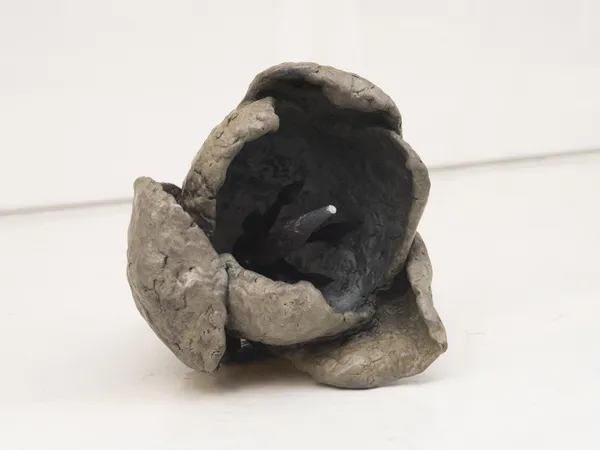
Also presented in the exhibition is the bronze sculpture First of the Twenty-Two (2026), which originates from a poem written during the artist’s residency at CastelGiocondo. The work reflects a sustained act of looking, in which the distance between observer and object gradually dissolves. Rather than depicting a moment of full bloom, the sculpture focuses on the threshold just before the formation of seeds—where growth and dissolution intersect, and time becomes perceptible as transition.
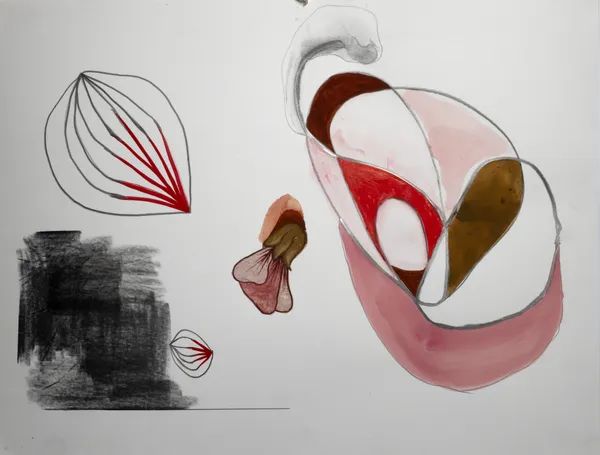
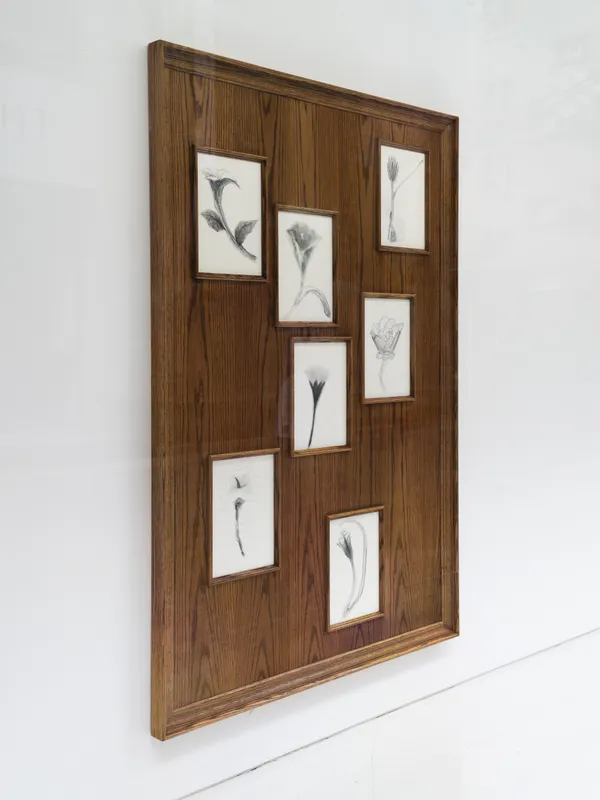
In the Seoul presentation at CHAPTER II, this sensibility extends into the urban context. Drawings installed within wooden frames along the window façade take as their point of departure the Art Deco floral ornamentation found within Castel Giocondo’s architecture, juxtaposing the immediacy of natural forms with their ornamental reconfiguration. This gesture reflects a recurring human impulse: even in environments where nature is abundant, it is continuously observed, reimagined, and translated into aesthetic form.
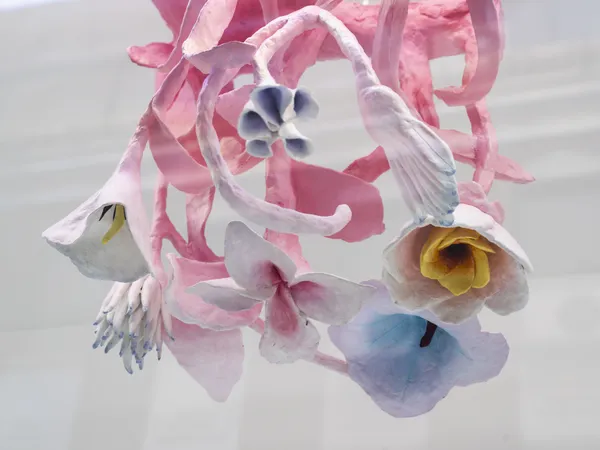
Following this inquiry, the artist retraces the origin of these ornamental motifs. By photographing the architectural decorations and identifying the corresponding botanical forms, Park reveals the distance between image and referent. This process unfolds across media—transforming into the Mockup for Pale Pink Universe -Bouquet Giocondo (2025), and returning again as drawing in Bouquet Giocondo d from s (2026). A single image migrates across forms, continuously rearticulated through different material states.
The video installation Pale Pink Universe (2025) mirrors this movement. Art Deco motifs appear, dissolve, and reassemble within the sequence of the moving image, eventually encountering the form of actual flowers. As in the passage from drawing to sculpture and back to drawing, images within the video continuously shift, extending into one another to form an unfolding visual continuum.
Park’s practice is shaped through this ongoing process of observation and transformation. Images move, reappear, and take on new forms, while layers of perception and time gradually emerge between them. The exhibition does not present a singular narrative, but invites viewers to attune themselves to subtle transitions—to move slowly between image and material, memory and presence.
In doing so, the viewer encounters what might be described as a dance to the music of time¹—an experience in which time unfolds not as a linear sequence, but as a rhythmic, resonant field shaped through perception.
¹ The phrase “a dance to the music of time” is drawn from Anthony Powell’s novel cycle A Dance to the Music of Time, itself inspired by Nicolas Poussin’s painting of the same title.
-
 Park Sun Min, Pale Pink Universe, 2025
 -
Park Sun Min, Pale Pink Universe -Bouquet Giocondo d 07, 2025
-
Park Sun Min, Pale Pink Universe -Bouquet Giocondo d 06, 2025
-
Park Sun Min, Pale Pink Universe -Bouquet Giocondo d 05, 2025
-
Park Sun Min, Pale Pink Universe -Bouquet Giocondo d fromd from S, 2026
-
Park Sun Min, Mockup for Pale Pink Universe -Bouquet Giocondo, 2025
-
Park Sun Min, First of the Twenty -Two, 2026
-
Park Sun Min, K’s Face, 2022
-
Park Sun Min, P’s Face, 2022